

Hotel Events and Banquet Scheduling

Last updated:
2/4/2026
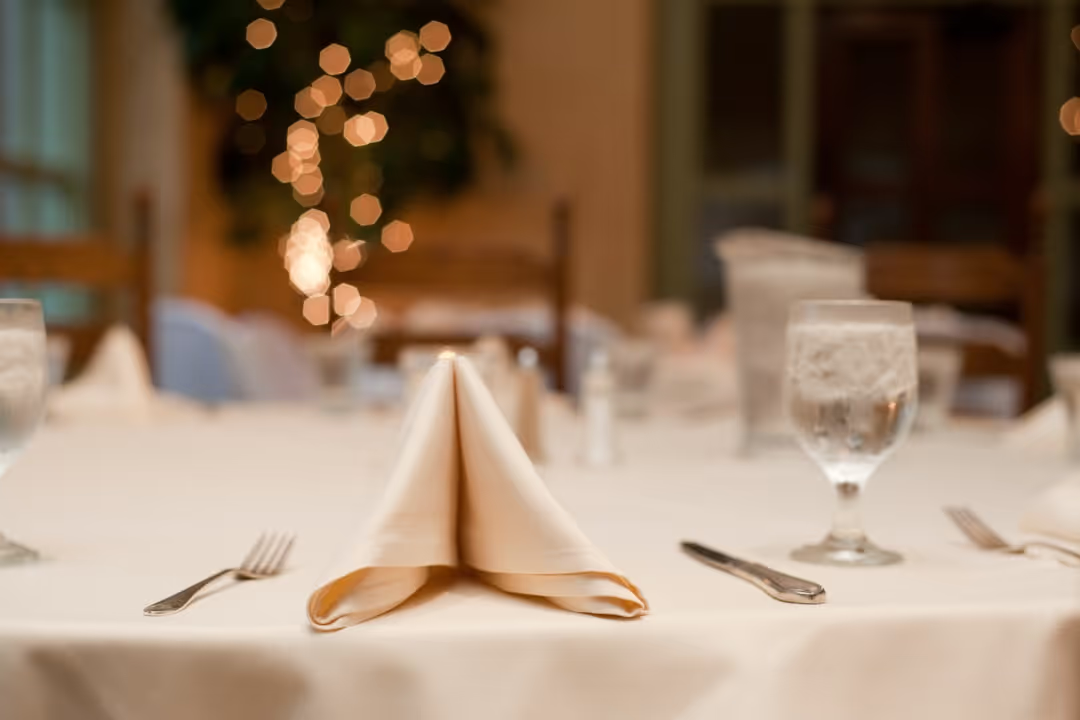
In brief: Hotel events and banquets (weddings, conferences, galas) require rapid scale-up: dozens of casual workers in the dining room, kitchen and dishwashing for a single evening. Event scheduling demands perfect coordination between departments, a reliable casual worker pool and impeccable administrative management (Dimona, hours, supplements). This guide covers banquet schedule organisation, casual worker management and coordination with the kitchen and floors. Shyfter simplifies event staffing from A to Z.
Hotel events: a scheduling exercise in its own right
A 200-guest wedding on a Saturday evening. A 3-day conference with 150 attendees. A 300-person year-end gala. Each event is unique in its size, duration, requirements and calendar. And each event requires staffing levels that far exceed the hotel's permanent team.
Event scheduling has nothing in common with the hotel's daily schedule. It operates by project: each event generates its own staffing needs, on specific time slots, with precise skills. The challenge is to integrate these one-off needs into the hotel's overall schedule without disrupting regular operations.
Event types and their staffing needs
Weddings
Weddings are the most frequent and demanding events. A 150-cover wedding typically requires: 8 to 12 servers in the dining room; 3 to 5 kitchen reinforcements (preparation, plating, dishwashing); 1 to 2 additional bartenders; 2 to 3 people for setup and breakdown. The total service duration often runs from 2pm (setup) to 4am (end of evening and cleanup). The schedule must provide for relay shifts: the casual workers doing setup are not the same ones who stay to the end.
Conferences and seminars
Conferences require fewer dining room staff but more versatility. Needs cover welcome, coffee breaks, lunches (buffet or seated), technical support and evening service if a gala dinner is planned. Duration can span several days, complicating planning.
Corporate galas and dinners
Galas concentrate the load on a single evening with high service standards. The server-to-guest ratio is tighter (1 server per 10–12 guests for quality seated service). Casual workers must be experienced and know service protocol.
Building and managing a casual worker pool
Why a structured pool is essential
In hotel events, the casual worker pool is your strategic resource. A wedding confirmed 3 months in advance needs confirmed casual workers at least 2 to 3 weeks before the event. Without a structured pool, you end up searching for servers at the last minute with people unfamiliar with your standards.
Sizing the pool
Basic rule: your pool must be 2 to 3 times larger than your maximum simultaneous needs. If your biggest event needs 15 casual workers, your pool must contain 30 to 45 people. This oversizing compensates for unavailability (casual workers and students have other commitments) and last-minute cancellations.
Classifying casual workers by skill
Not all casual workers are interchangeable. Classify your pool by skill: dining room service (plate service, buffet, tray service); bar (cocktails, bar service, managing a pop-up bar); kitchen (preparation, dressing, dishwashing); setup (table installation, decoration, breakdown); welcome (cloakroom, guest direction, table plan management).
Retaining the best casual workers
Good casual workers are rare. To retain them: offer them priority for the best-paid events; pay on time (delayed payment is the primary cause of losing casual workers); communicate schedules in advance; provide good working conditions (meals, breaks, respecting announced hours).
Planning an event: from confirmation to breakdown
D-30: confirmation and initial calculations
As soon as the event is confirmed, calculate staffing needs by position and time slot, based on the number of covers, type of service (seated, buffet, cocktail), event duration and client requirements. Send these needs to your casual worker pool via Shyfter. Available casual workers confirm their presence directly in the app. You immediately know if you have enough people or need to expand the search.
D-7: detailed schedule and briefing
One week before the event, finalise the schedule with names, positions and precise hours. Provide for: arrival time for each casual worker (30 minutes before the event starts for the briefing); position allocation (who does service, who does bar, who does dishwashing); relays (who leaves at 11pm, who stays to the end); the on-site coordination manager (maitre d' or events manager).
Day of event: real-time coordination
On the day, the schedule must be accessible to all participants. Last-minute changes (a casual worker cancels, one more guest, a menu change) must be communicated instantly. The mobile app is the coordination tool of choice.
D+1: debrief and administrative follow-up
After the event, validate actual hours for each casual worker (digital time-tracking simplifies this step). File Dimona declarations if not done in advance. Document feedback to improve the organisation of the next event.
Coordination with the kitchen
Impact on the kitchen brigade
A 200-cover banquet is the equivalent of 2 to 3 restaurant services concentrated in a single send. The hotel's permanent kitchen cannot absorb this load alone. Reinforcements are needed: additional commis, a banquet chef de partie, extra dishwashers. The kitchen schedule for an event must be coordinated with the head chef from the moment of confirmation: How many kitchen reinforcements? At what time does preparation start? Is the hotel restaurant open in parallel? Is the next morning's breakfast affected (same exhausted brigade)?
Anticipating resource conflicts
On a Saturday evening wedding, the hotel restaurant is also open to resident guests. The kitchen must handle both services in parallel. The schedule must provide for separate staffing for the banquet and the restaurant, or limit the restaurant's capacity that evening. This decision is made in advance, not on the day.
Coordination with housekeeping
Before the event
Banquet rooms must be cleaned and prepared before setup. If the event includes group accommodation (wedding with reserved rooms), housekeeping must prepare a block of rooms at the same time. This double load must be anticipated in the floors schedule.
After the event
The day after a wedding, the banquet room needs a deep clean. The guest group checks out, generating a peak of rooms to prepare. Housekeeping needs reinforcements the next morning. Factor this post-event load into the schedule from the moment of confirmation.
Administrative obligations for events
Dimona for every casual worker
Every casual worker engaged for an event must be declared via Dimona before the start of their shift. For an event with 15 casual workers, this means 15 individual declarations. Shyfter automates these declarations: as soon as a casual worker is confirmed in the schedule, the Dimona is generated.
Hour tracking and supplements
Events often run in the evening and at weekends. Supplements accumulate: night (after 8pm), Sunday, public holidays. Time-tracking must record the exact start and end times for each casual worker. Hours declared to the payroll provider must match actual hours.
Casual worker status: legal limits
A hospitality casual worker can be engaged for a maximum of 2 consecutive days with the same employer. For a 3-day conference, a casual worker working all 3 days legally moves into a standard employment contract. Anticipate this by rotating casual workers across long events.
Optimising event staffing
The right staff-to-guest ratio
- Premium seated service: 1 server per 10–12 guests
- Standard seated service: 1 server per 15–18 guests
- Buffet: 1 server per 25–30 guests (beverage service + clearing)
- Cocktail: 1 server per 20–25 guests (tray passing + bar)
Avoiding overstaffing
Too many casual workers costs money and creates confusion. A casual worker without a clear task for 2 hours is a dead cost. Calculate needs by time slot: setup needs fewer people than service, and service needs fewer than breakdown + cleanup. Plan staggered departures rather than keeping everyone to the end.
FAQ
How many casual workers do you need for a 150-cover wedding?
For a 150-cover seated service, plan 10 to 12 servers in the dining room, 3 to 5 kitchen reinforcements and 1 to 2 bartenders. Add 2 to 3 people for setup and breakdown, who are not necessarily the same as the evening servers. Total: 16 to 22 people with staggered hours by position. Maintain a standby pool of 30 to 40 people to be sure of reaching these numbers.
How do you manage Dimona declarations for an event with 15 casual workers?
Each casual worker must have an individual Dimona declaration filed before the start of their shift. With Shyfter, declarations are generated automatically when you assign a casual worker to an event shift. The tool also keeps a record of all declarations for administrative tracking and potential social inspectorate checks.
How do you avoid conflicts between banquet service and the hotel restaurant on the same evening?
Anticipate the issue from the moment the event is confirmed. Three options: plan separate teams for the banquet and restaurant (more costly but safer); limit the restaurant's capacity on the event evening; or close the restaurant to external guests that evening. The decision depends on the size of the event and your brigade's capacity. In all cases, plan kitchen and dining room staffing separately for each service.